What happens between pressing scan and reading a finding
No black box. This is the whole path, in the order it runs.
1. Authorisation, before anything is sent
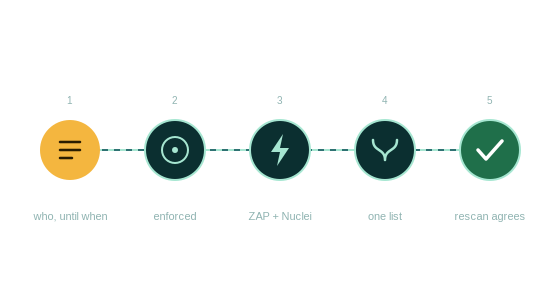
An asset cannot be scanned until someone with authority has recorded who approved the testing, under what reference, and until when. The worker re-checks that record the moment the job starts, so revoking it stops a scan that is already queued. There is no override in the console.
2. Scope, enforced in the product
A scan stays on the target host and its subdomains. Include and exclude patterns are applied to every finding before it is stored, so a crawler that wandered cannot widen the engagement after the fact. Cloud instance-metadata addresses are refused outright as targets, by anyone, always.
3. Nuclei sweeps, ZAP goes deep
Nuclei runs its template library for known CVEs, exposures and misconfiguration. ZAP builds a context scoped to the asset, signs in if the profile has credentials, imports an API definition if you gave one, crawls, waits for its passive rules to drain, then runs the active scan unless the profile is production-safe.
4. Correlation, which is the actual work
Both engines' output is normalised and grouped. Two reports are the same finding when they are the same rule class — CWE first, then a short list of rule families — on the same asset, at the same normalised location, on the same parameter. The strongest report sets the headline; the rest become evidence on the same finding.
5. Scoring, so the list has an order
Engine severity or CVSS, weighted by how critical the asset is to you, whether it is production, how confident the check is, and whether the flaw is known to be exploited in the wild. One number out of 100, and a remediation deadline from your own policy.
6. Proof, before anything closes
A finding is marked fixed only when a later scan that ran the same engine no longer sees it. A Nuclei-only sweep never closes something only ZAP could find. A retest speaks only for the finding it was asked about. Nobody can simply tick "fixed".
7. Where it all runs
On Microsoft Azure, behind Cloudflare. Each scan gets its own engine process and its own ZAP context, removed when the job ends. Workspaces are kept apart in the database layer, stored credentials are encrypted, and we do not train AI models on your data. The detail is on the security page.
What you get out of it
A findings list ordered by real risk, a one-page executive summary, a technical report with evidence and a reproduction per finding, a spreadsheet, and a scan-to-scan diff that answers "what changed since the release" without a human comparing two PDFs.