Findings your auditor can trace to a control
Every finding carries its mapping to the frameworks your clients and regulators ask about — including the two the international tools leave out, because we sell where they are mandatory.
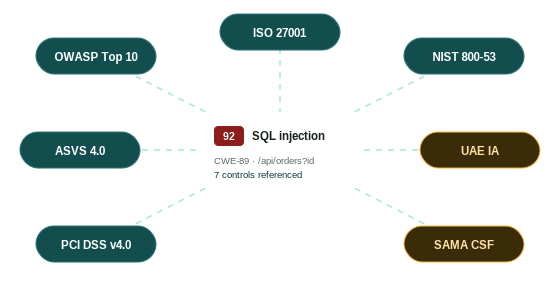
Frameworks we map to
OWASP Top 10 (2021)
The category every developer already recognises, on every finding and on the dashboard.
OWASP ASVS
The verification section a tester works to, so a finding points at the control that should have caught it.
PCI DSS
The requirement number, for anyone handling card data.
ISO/IEC 27001:2022
Annex A controls, for the certification most enterprise buyers ask for.
NIST SP 800-53
Control identifiers, for US-aligned programmes.
UAE Information Assurance
The UAE IA controls that apply to entities operating in the Emirates.
SAMA Cyber Security Framework
For financial institutions regulated in Saudi Arabia.
The mapping itself
This table is generated from the same mapping the product applies to findings, so what you read here is what appears in your report.
| Weakness | OWASP Top 10 | ASVS | PCI DSS | ISO 27001 | NIST | UAE IA | SAMA |
|---|---|---|---|---|---|---|---|
| Access to another user's records (BOLA / IDOR) CWE-639 |
A01:2021 Broken Access Control | V4.2 Operation Level Access Control | 7.2.1 | A.8.3 Information access restriction | AC-3 | T3.3.1 Identity and access | 3.3.6 Identity and access management |
| Broken or risky cryptography CWE-327 |
A02:2021 Cryptographic Failures | V6.2 Algorithms | 4.2.1 | A.8.24 Use of cryptography | SC-13 | T3.5.1 Cryptography | 3.3.11 Cryptography |
| Cleartext transmission CWE-319 |
A02:2021 Cryptographic Failures | V9.1 Client Communication | 4.2.1 | A.8.24 Use of cryptography | SC-8 | T3.5.1 Cryptography | 3.3.11 Cryptography |
| Clickjacking / improper restriction of frames CWE-1021 |
A05:2021 Security Misconfiguration | V14.4 HTTP Security Headers | 6.5.1 | A.8.9 Configuration management | SC-18 | T3.2.3 Secure configuration | 3.3.5 Configuration management |
| Configuration CWE-16 |
A05:2021 Security Misconfiguration | V14.1 Build and Deploy | 2.2.1 | A.8.9 Configuration management | CM-6 | T3.2.3 Secure configuration | 3.3.5 Configuration management |
| Cross-site request forgery CWE-352 |
A01:2021 Broken Access Control | V4.2 Operation Level Access Control | 6.5.9 | A.8.28 Secure coding | SI-10 | T3.2.5 Application security | 3.3.14 Application security |
| Cross-site scripting CWE-79 |
A03:2021 Injection | V5.3 Output Encoding | 6.2.4 / 6.5.7 | A.8.28 Secure coding | SI-10 | T3.2.5 Application security | 3.3.14 Application security |
| Directory listing exposed CWE-548 |
A05:2021 Security Misconfiguration | V14.3 Unintended Information Leakage | 6.5.6 | A.8.9 Configuration management | CM-6 | T3.2.3 Secure configuration | 3.3.5 Configuration management |
| Hard-coded or default credentials CWE-798 |
A07:2021 Identification and Authentication Failures | V2.1 Password Security | 8.3.1 | A.5.17 Authentication information | IA-5 | T3.3.1 Identity and access | 3.3.6 Identity and access management |
| Improper access control CWE-284 |
A01:2021 Broken Access Control | V4.1 General Access Control | 7.2.1 | A.8.3 Information access restriction | AC-3 | T3.3.1 Identity and access | 3.3.6 Identity and access management |
| Improper authentication CWE-287 |
A07:2021 Identification and Authentication Failures | V2.1 Password Security | 8.3.1 | A.5.17 Authentication information | IA-2 | T3.3.1 Identity and access | 3.3.6 Identity and access management |
| Improper output neutralization for logs CWE-117 |
A09:2021 Security Logging and Monitoring Failures | V7.1 Log Content | 10.2.1 | A.8.15 Logging | AU-2 | T3.6.1 Logging and monitoring | 3.3.13 Logging and monitoring |
| Information disclosure CWE-200 |
A01:2021 Broken Access Control | V14.3 Unintended Information Leakage | 6.5.6 | A.5.12 Classification of information | SC-30 | T3.2.5 Application security | 3.3.14 Application security |
| Missing authentication for a protected function CWE-306 |
A07:2021 Identification and Authentication Failures | V4.1 General Access Control | 8.2.1 | A.8.5 Secure authentication | IA-2 | T3.3.1 Identity and access | 3.3.6 Identity and access management |
| Missing protection mechanism CWE-693 |
A05:2021 Security Misconfiguration | V14.4 HTTP Security Headers | 6.5.1 | A.8.9 Configuration management | CM-6 | T3.2.3 Secure configuration | 3.3.5 Configuration management |
| Missing role check (function level authorisation) CWE-285 |
A01:2021 Broken Access Control | V4.1 General Access Control | 7.2.2 | A.8.2 Privileged access rights | AC-6 | T3.3.1 Identity and access | 3.3.6 Identity and access management |
| No limit on resource use (e.g. GraphQL batching) CWE-770 |
A04:2021 Insecure Design | V11.1 Business Logic Security | 6.2.4 | A.8.28 Secure coding | SC-5 | T3.2.5 Application security | 3.3.14 Application security |
| Open redirect CWE-601 |
A01:2021 Broken Access Control | V5.1 Input Validation | 6.5.1 | A.8.28 Secure coding | SI-10 | T3.2.5 Application security | 3.3.14 Application security |
| OS command injection CWE-78 |
A03:2021 Injection | V5.3 Output Encoding | 6.2.4 / 6.5.1 | A.8.28 Secure coding | SI-10 | T3.2.5 Application security | 3.3.14 Application security |
| Path traversal CWE-22 |
A01:2021 Broken Access Control | V12.3 File Execution | 6.5.8 | A.8.3 Information access restriction | AC-3 | T3.2.5 Application security | 3.3.14 Application security |
| Server-side request forgery CWE-918 |
A10:2021 Server-Side Request Forgery | V12.6 SSRF Protection | 6.5.1 | A.8.28 Secure coding | SC-7 | T3.4.1 Network security | 3.3.9 Network security |
| SQL injection CWE-89 |
A03:2021 Injection | V5.3 Output Encoding | 6.2.4 / 6.5.1 | A.8.28 Secure coding | SI-10 | T3.2.5 Application security | 3.3.14 Application security |
| Unmaintained third-party component CWE-1104 |
A06:2021 Vulnerable and Outdated Components | V14.2 Dependency | 6.3.3 | A.8.8 Technical vulnerabilities | SI-2 | T3.2.4 Patch management | 3.3.15 Patch management |
| Unsafe deserialization CWE-502 |
A08:2021 Software and Data Integrity Failures | V5.5 Deserialization | 6.5.1 | A.8.28 Secure coding | SI-10 | T3.2.5 Application security | 3.3.14 Application security |
| XML external entity CWE-611 |
A05:2021 Security Misconfiguration | V5.5 Deserialization | 6.5.1 | A.8.9 Configuration management | SI-10 | T3.2.5 Application security | 3.3.14 Application security |
A finding whose weakness is not in this table still carries its OWASP category, worked out from the rule, and appears in reports under technical vulnerability management.