Subdomain discovery
The server that gets breached is the one nobody remembered.
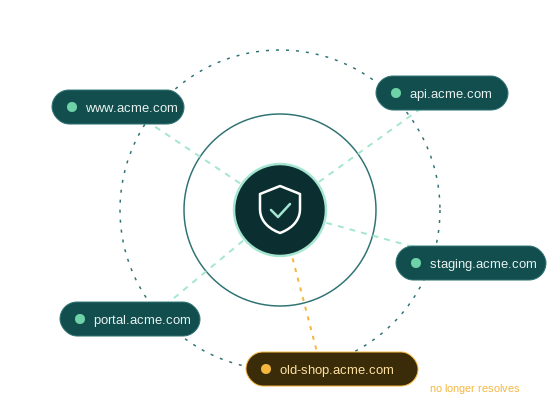
Sentry reads the public certificate logs for your domains and lists every hostname you have no record of — the staging box, the old campaign site, the name that no longer points anywhere. Nothing is sent to your infrastructure to find them.
Reports that hold up
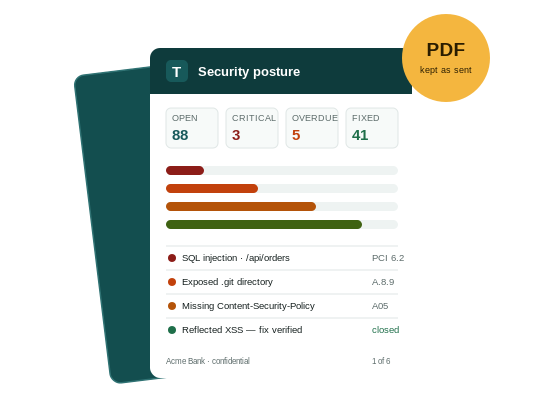
A PDF your client can read and your auditor can trace.
Executive summary, full technical detail, and a control-by-control position against PCI DSS, ISO 27001, NIST, UAE IA and SAMA CSF. Every report is kept exactly as it was sent, so March’s document still says what it said in March.
Certificate monitoring
An expired certificate is an outage with a date on it.
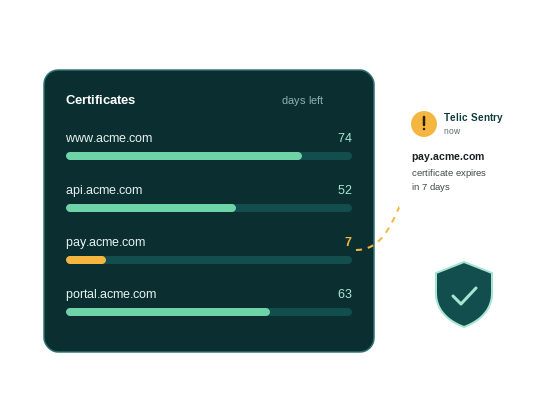
Sentry checks the certificate on every asset daily and warns at thirty, fourteen, seven, three and one day — by e-mail, chat or WhatsApp. It also tells you when the issuer changes, which is how a mis-issued certificate gets noticed.
From sign-up to a ranked list in three steps
-
1
Add a site or API
Paste a URL or an OpenAPI file. Say how critical it is and whether it is production; that is what the risk score weighs it by.
-
2
Prove it is yours
Record who authorised the scan and until when, or publish one DNS record. Nothing is scanned without it, and the scanner checks again as it starts.
-
3
Work one list
ZAP and Nuclei run, their reports merge into one finding per real issue, ranked 0 to 100. Fix it, and a retest closes it.
Why running the two scanners yourself is the hard part
ZAP and Nuclei are excellent and free. What costs a team its evenings is everything that happens after they finish.
They overlap, and disagree
A ZAP reflected-XSS alert and a Nuclei XSS template on the same parameter are one bug, reported twice, at two different severities. Sentry correlates them on CWE and keeps both as evidence on a single finding.
Last night's list is new again
Rerun a scan and an id in a URL moves, so everything looks new. Sentry fingerprints a finding on the asset, the rule and a normalised location, so "what changed since the last scan" is a real answer rather than a diff of noise.
Nobody can prove the fix
A finding is only closed when a later scan that ran the same checks no longer sees it. A Nuclei-only sweep never closes something only ZAP could find, and "fixed" is never something a person can simply tick.
Risk you can work in order
Every scanner calls things critical. Sentry weighs the engine's severity against the asset — how critical it is to you, whether it is production, how confident the check is, and whether the flaw is on CISA's known-exploited list — into one score out of 100. A medium on a live payment page outranks a high on a developer's test box, which is the order a real team fixes things in.
Mapped to the frameworks your clients audit against
Every finding carries its OWASP Top 10 category, ASVS section, PCI DSS requirement, ISO 27001 control, NIST 800-53 control, and — because we sell into the Gulf — UAE IA and SAMA CSF.
See the mappingReports you can hand over
A one-page executive summary, a technical report with evidence and a reproduction for every finding, a spreadsheet for whoever wants to sort it, and a scan-to-scan diff for the question every client asks after a release.
What's in the productThese are the controls each finding relates to, to save you the cross-referencing. They are not certifications, and a scan alone does not make a system compliant.
Fits the tools your team already uses
Findings go where the work happens. Every one of these is in the product today.
We will not scan something you do not own
Authorisation is a gate, not a checkbox
No scan starts, or continues, without a current written authorisation recorded against the asset: who approved it, under what reference, and until when. The worker re-checks it at the moment the scan begins, so revoking it stops a job that is already queued. It cannot be overridden from the console. Even our free full sweep requires you to prove the domain is yours first.
That is the difference between a security product and an attack tool, and it is the first thing an enterprise or government buyer asks about.
Sentry against running the scanners yourself
| Doing it yourself | Telic Sentry | |
|---|---|---|
| Two reports that overlap | De-duplicated by hand, every time | One finding per real issue |
| Knowing what to fix first | Everything is critical | A 0–100 score from your context |
| Proving a fix | Somebody says it is done | Closed only by a scan that no longer sees it |
| A report for a client | Hours in a word processor | Executive, technical and spreadsheet, on a schedule |
We also say plainly where Detectify, Intruder and the other established scanners are ahead. The full comparison
From the people who run the scanners
Short guides on the questions we are asked most.
The subdomain nobody remembered: finding your real attack surface
Read the guide →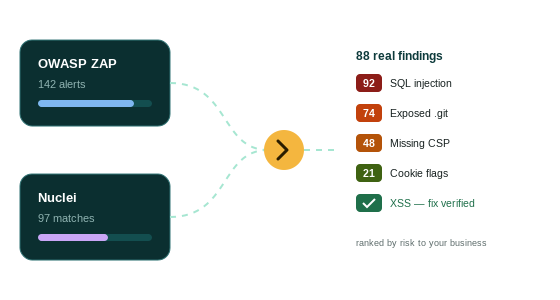
OWASP ZAP vs Nuclei: what each one finds, and why you run both
Read the guide →Security headers: the six worth setting first, in order
Read the guide →Questions people ask before they try it
Is the free website security check safe to run on a live site?
Yes. It is passive: we fetch the home page once, complete one TLS handshake and read public DNS. No payload is sent and nothing is crawled, so it does exactly what an ordinary visitor's browser does.
Do I need to prove I own a domain before a full scan?
Yes. The free external checks run on any domain because they only read public information, but a real vulnerability sweep needs a published DNS TXT record or a file on the site proving control, and the authorisation is recorded against the asset.
How is Telic Sentry different from running OWASP ZAP and Nuclei myself?
Both engines are free and excellent. Telic Sentry does what comes after them: correlating the two reports onto one finding per real issue, keeping a stable identity across scans so a diff means something, scoring by the asset's business context, and only closing a finding when a later scan running the same checks no longer sees it.
Which compliance frameworks do the findings map to?
Every finding carries its OWASP Top 10 category, OWASP ASVS section, PCI DSS requirement, ISO 27001 control, NIST 800-53 control, UAE Information Assurance control and SAMA Cyber Security Framework control.
Two ways to start, both free
Check one site now
Headers, TLS, e-mail spoofing and DNS in a few seconds. No sign-up, and no payload is ever sent.
Prove the domain is yours and we run a full non-intrusive sweep with the real engine. Verify a domain
Start a 14-day trial
Every feature switched on: both engines, authenticated scanning, reports, tickets and the API. Create a Telic ID, name your workspace, add a site.
Get started freeNo card needed. Plans never renew by themselves, so there is nothing to cancel. See pricing