Everything between "run a scanner" and "the bug is fixed"
The engines are open source and excellent. What a team pays for is the work around them: scope, scheduling, correlation, triage, proof, and something a client can read.
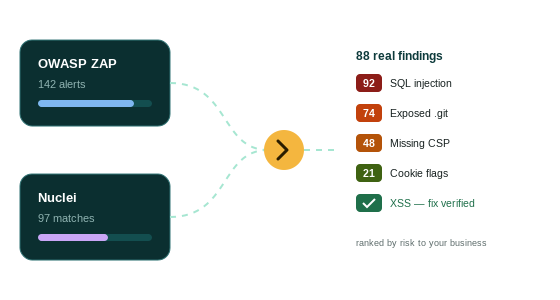
Scanning
Nuclei, for breadth
Thousands of community templates for known CVEs, exposed panels, default credentials, leaked configuration and misconfiguration — a sweep in minutes.
OWASP ZAP, for depth
Crawl and active scan of the application itself, including the scripted pages a plain crawler never reaches, with attack strength and alert threshold per profile.
Authenticated scanning
Form, JSON, HTTP basic, bearer-token and script-based logins. Credentials are encrypted at rest and never shown again. The logout URL is excluded by default, which is the single most common reason an authenticated scan quietly finds nothing.
APIs, not just pages
Import an OpenAPI, GraphQL or SOAP definition and scan the endpoints it declares, without relying on a crawler to discover them.
Production-safe profiles
A profile marked safe for production has its active scan turned off and the intrusive, fuzzing, brute-force and denial-of-service templates stripped — enforced at the command line, not just labelled in the UI.
Scheduling and change detection
Cron schedules in your own time zone, a priority queue so an urgent retest jumps a nightly estate sweep, and cancellable jobs that keep what they already found.
Findings
One finding per issue
Correlated across both engines on CWE and rule family, fingerprinted on the asset, rule and a normalised location so a rotating id in a URL does not invent a new finding every night.
Business risk, not engine severity
Severity weighted by asset criticality, environment, confidence and exploitability — CISA KEV and EPSS — into one score out of 100.
Triage that holds its shape
A full lifecycle with assignment, comments and a severity override that records who changed it and why, alongside what the engine originally said.
Decisions that expire
Accepting a risk or calling a false positive needs a reason and a review date. When the date passes and a scan still sees the issue, it reopens by itself.
Remediation deadlines
Days per severity, set per workspace, with a sweep that marks a breach once and raises an event — so "past due" has a timestamp you can report on.
Retest a single finding
Check one URL for one issue to close a ticket, instead of making a developer wait for a full scan.
Fitting into how you already work
A pipeline gate
GET /v1/gate?scanJobId=…&failOn=High answers
pass, fail, pending or error
as a field, so a build step never reads a still-running scan as a failure.
A real API
Assets, scans, findings, posture and retests over REST with scoped keys and an OpenAPI document. A read key is an auditor; a write key can queue and triage but never accept risk.
Signed webhooks
scan.completed, finding.new and
finding.sla_breached, signed over timestamp and body so a replay can
be rejected, with a widening retry schedule.
Roles that match a real team
Auditor reads. Developer sees only assets they own. Analyst scans and triages. Admin accepts risk and manages credentials. Owner cannot be removed by an admin.
Honest about what is not built yet
These are designed and on the roadmap, and are not in the product today. We would rather you heard it here than discovered it in a trial.
Jira and Azure Boards sync Planned
Findings currently carry an external ticket reference you can set; two-way sync is not built.
Internal network agent Planned
For scanning applications that never face the internet.
Subdomain discovery Planned
Assets are added by you or through the API today.